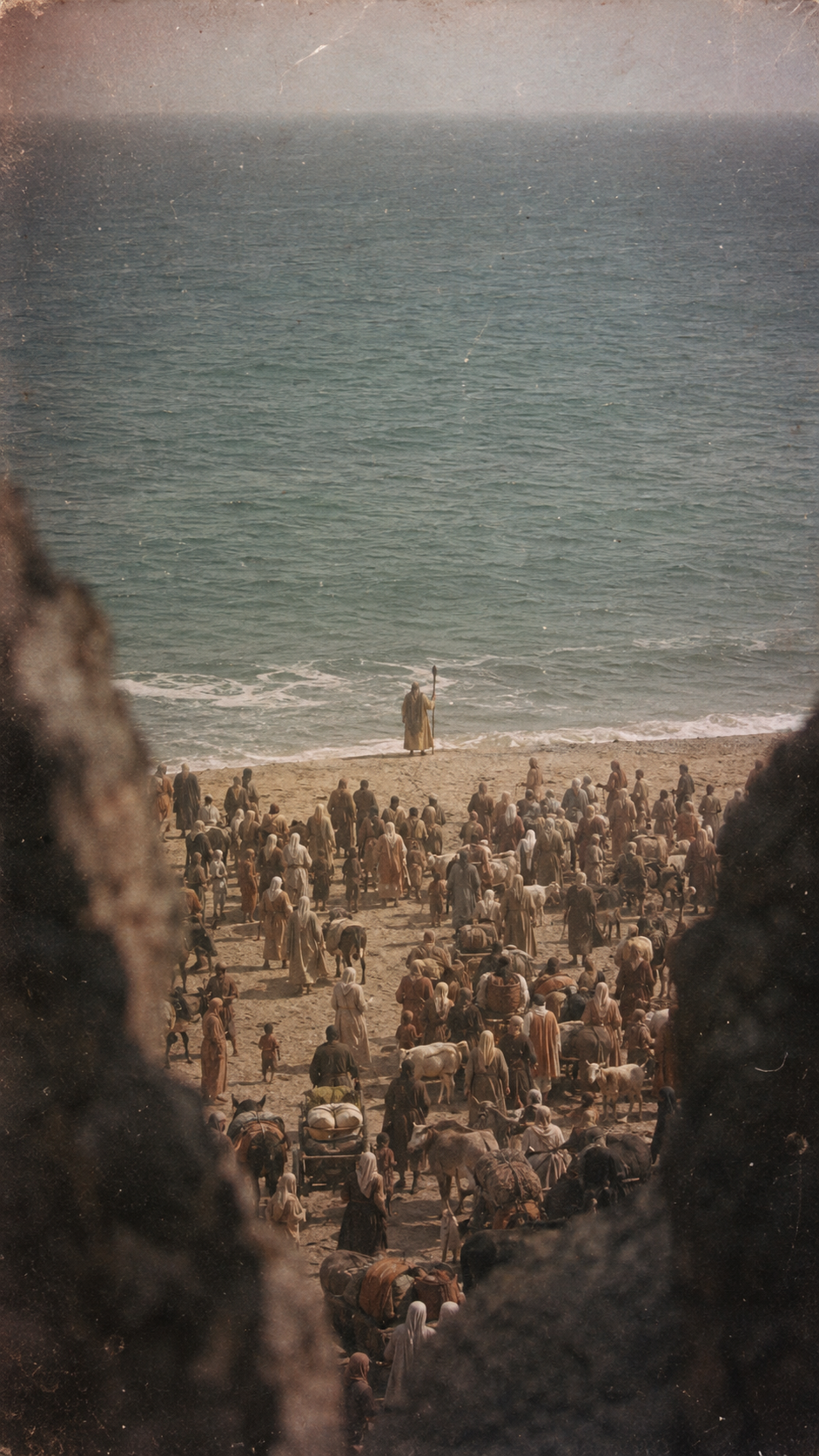
Step 1. Place this image prompt and tell Chat GPT to hold
(이미지 프롬트를 챗지피티에게 주고 대기하라고 한다)
Create a vertical 9:16 fictional biblical scene photographed as a badly faded frame from a secretly discovered 1960s expedition film. Show a real-looking distant event through primitive telephoto optics, with weathered film texture rather than polished biblical illustration.
The hidden observer is on a high rocky ridge above the destination shore, looking diagonally downward toward the exit of a parted sea. Dark blurred rocks and dry branches partially obstruct the frame edges. The camera faces back along the exposed seabed toward the distant pursuing army. The safe shore occupies the lower foreground, the corridor opens near the center, and the passage extends far into the upper background between two enormous walls of seawater.
Most of the Israelite refugees have already emerged onto this safe shore. Exhausted families, carts, bundled possessions, sheep, goats, donkeys and cattle crowd the beach. Some people kneel with bowed heads; others sit or lie exhausted beside their belongings, visibly alive. A few have stumbled onto their hands and knees. Relatives support them and move cargo away from the passage. Several survivors turn toward the remaining travelers and urgently wave for them to hurry.
Moses stands just outside the exit, slightly to one side so he does not block the escape route. He is an elderly Middle Eastern man with weathered skin, long gray-white hair and a full beard, wearing a dusty cream robe, brown mantle and worn sandals. His crooked wooden staff is planted in the sand beside him, leaving his hands free. He leans toward the corridor and urgently beckons the remaining people toward safety. His expression is alarmed and decisive.
Approximately twelve meters inside the passage, a clearly adult Middle Eastern woman struggles toward Moses with a small child and a young goat. She wears a faded rust-brown robe and a dark head covering. One hand holds the child’s hand while the other holds the goat’s slack lead rope. The exhausted child stumbles along beside her. The young goat hesitates on the wet ground. Their bodies lean forward with effort. Keep these three figures clearly separated and visible against the pale seabed.
Far behind them, hundreds of Egyptian soldiers pursue through the same exposed corridor. Dense ranks of infantry run with spears and shields; mounted riders and horse-drawn chariots follow among the formations. Bronze helmets and armor, linen garments, leather straps, painted shields and moving standards create a distinct Egyptian army silhouette. The pursuers remain much farther away than the woman, child and goat, separated by a long stretch of open seabed.
Both water walls are still standing in the starting frame. Their surfaces churn, ripple and shed mist, with large waves traveling along the upper edges. The central route remains exposed and continuous from the distant army to the safe beach. Do not show the sea already closing.
The composition must make the geography immediately understandable: safe refugees on the near shore; Moses at the exit; the last woman, child and goat approaching him; the Egyptian army pursuing far behind; towering moving water on both sides. Keep everyone distant within the monumental landscape, without sharp facial close-ups.
Use dusty gray daylight, faded blue-green water, beige sand, weak cream highlights and muted brown clothing. Strong sea haze and telephoto compression soften the distance. Authentic deteriorated color film: coarse organic grain, faded dyes, low contrast, muddy shadows, washed highlights, duplication blur, lens haze, slight halation, scratches, dust and chemical stains. No modern equipment, Roman armor, medieval armor, glowing effects, HDR, polished CGI, captions, text, logo or watermark.
Step 2. Place the video prompt below and tell Chat GPT to hold
(이미지 프롬트를 챗지피티에게 주고 대기하라고 한다)
An 8-second continuous shot using the reference image. Vertical 9:16. A fictional biblical reenactment with the appearance of badly preserved, faded 1960s amateur expedition footage, secretly filmed from a high rocky ridge above the destination shore.
GEOGRAPHY
The safe beach is in the lower foreground. The exit of the parted sea is in the middle of the frame. The exposed seabed corridor extends away into the distant background between two immense, turbulent walls of seawater.
Most Israelites, their loaded wooden carts, bundles and livestock are already on the safe beach. Several exhausted people sit, kneel or lie on the sand, visibly alive and moving. Others urgently beckon to the last people still inside the corridor.
Moses stands immediately beside the exit. He has weathered features, a gray-white beard, a faded cream robe and a brown mantle. His wooden staff is planted in the sand beside him, leaving both hands free.
The last woman, wearing a faded rust-brown robe and dark head covering, is ONLY THREE TO FOUR METERS inside the exit, struggling forward with a small child and a small young goat. A huge Egyptian army runs and rides through the corridor far behind them. Keep the pursuing army distant.
ACTION TIMING — FAST, OVERLAPPING, PHYSICALLY CONTINUOUS
0.0–1.2 seconds:
Moses urgently beckons to the woman, child and goat, then immediately steps toward them. The woman hurries but the child stumbles and the goat hesitates. People on the beach wave them forward; one kneeling refugee reaches toward the exit while another helps an exhausted companion sit up. Distant Egyptian infantry, horsemen and chariots advance continuously.
1.2–2.8 seconds:
Moses rushes the few remaining steps into the corridor. In one continuous hurried movement, he bends, gathers the child into one arm and scoops the small goat into his other arm. Support the child beneath the seat and against his chest; support the goat beneath its torso, never by its horns or neck. The woman releases the goat’s slack lead and immediately turns to run beside him.
As Moses finishes lifting them, the seawater walls begin collapsing FAR IN THE BACKGROUND around the pursuing army. The near exit remains open.
2.8–5.5 seconds:
Moses runs toward the beach carrying the child and goat securely, with the woman running directly beside him. His steps are short, hurried and visibly burdened by their weight.
Behind them, the distant water walls crash inward and the closure rapidly progresses toward the shore. The distant army disappears behind turbulent water, foam and spray without graphic injury. The remaining open corridor shortens behind the fleeing group. Do not close the water in front of Moses.
People on shore keep moving: they reach toward the family, pull exhausted companions away from the waterline, guide livestock farther inland and drag the nearest cart clear.
5.5–7.0 seconds:
Moses and the woman scramble across the exit onto the beach just before the final section collapses behind them. Spray strikes their backs and a shallow wash splashes their feet and robe hems. The child and goat remain held above the water. They are briefly wet but never submerged or swept away.
A waiting refugee steadies the woman as she reaches dry sand. Moses takes two more stumbling steps inland with both rescued passengers still securely in his arms.
7.0–8.0 seconds:
The passage has become a continuous, violently churning sea. Moses sinks to one knee on safe sand, still supporting the child and goat. The woman turns toward the child and reaches to embrace them. Nearby refugees crowd closer in relief while others remain exhausted on the ground. End abruptly with everyone in the rescued group clearly alive and safely ashore.
CAMERA AND AGED FILM
Remain at the same hidden, elevated observation point throughout. A distant, steep downward telephoto view, with blurred rocks partially obstructing the bottom and one side of the frame. Preserve enough width to show the family, the exit and the approaching collapse simultaneously.
The camera operator reacts late: small irregular hand tremors, a brief angular correction as Moses runs, and a slightly stronger flinch when the near water crashes. Never lose the rescue behind foreground rocks. No cuts, close-ups, drone movement, smooth tracking, gimbal stabilization or cinematic slow motion.
Make the motion itself feel old: uneven low-frame-rate cadence resembling 16 fps, brief motion smearing, slight frame-registration jitter and imperfect manual focus. Actions still happen at normal speed.
Faded dusty brown, gray-green seawater, weak cyan shadows, muted skin tones, low contrast, pale washed-out highlights, soft detail, coarse moving film grain, subtle exposure flutter, occasional dust and fine scratches. Humid sea haze reduces distant detail. This must look like a worn duplicate of old amateur footage, not sharp modern footage with a sepia filter. No HDR, glossy fantasy lighting or polished VFX appearance.
SOUND — DISTANT OBSERVER PERSPECTIVE
Nearby ridge wind and faint camera mechanism noise sit over the remote scene. Refugee calls, hoofbeats, cart rattles and the goat’s bleat are tiny, muffled and indistinct from this great distance. No intelligible dialogue or close breathing.
The sea produces a broad, distant rushing roar that grows as the collapse approaches the shore, remaining spatially below and far from the microphone. Major visible impacts are followed by slightly delayed, softened sound. No close explosive crash, cinematic bass hit or artificially amplified footsteps. Camera movement does not change microphone distance.
No music, choir, narration, subtitles or text.
CONTINUITY
One Moses, one woman, one child and one small goat throughout. The staff stays planted on shore. No teleportation, duplicated limbs or passengers, instant costume changes, frozen background crowds or weightless running. Moses visibly lifts both passengers before carrying them. The sea closes from the far background toward the exit, and the family reaches safety before the final collapse.
Step 3.
Tell Chat GPT the story that you want to create, and tell him what kind of first frame image you want. And at the end tell him to write you an image prompt and the video prompt.
EX) Let’s create story of Samson, he is captured in a temple and people are mocking him, he is tide up to two pillars, people throw food at him and mock him and laugh at him, but he roars and pushes the pillars breaking the temple down and making all the people in the temple get buried under the temple. create a starting frame image prompt and a video prompt for this scene.
ChatGPT에게 만들고 싶은 이야기와 원하는 첫 장면 이미지의 구도를 설명하세요. 그리고 마지막에 해당 장면을 위한 이미지 프롬프트와 영상 프롬프트를 작성해 달라고 요청하세요.
예시) 삼손의 이야기를 만들어보자. 삼손은 신전에 붙잡혀 있고, 사람들은 그를 조롱하고 있다. 그는 두 개의 기둥 사이에 묶여 있으며, 사람들은 그에게 음식을 던지면서 비웃고 큰 소리로 웃는다. 하지만 삼손은 크게 포효하며 기둥을 밀어 쓰러뜨리고, 신전 전체가 무너지면서 신전 안의 사람들이 잔해에 파묻힌다.
이 장면의 시작 프레임 이미지 프롬프트와 영상 프롬프트를 작성해 줘.
Step 4.
Go to OpenArt and place the image prompt using Chat GPT iamge2 model and get the image. Then go to video, choose Seedance2.5 image to video feature, place the Samson image as the first starting frame, copy paste the video prompt that Chat GPT wrote for you, select 8seconds(according to the length you want), and done.
OpenArt에 접속한 뒤, ChatGPT Image 2 모델을 선택하고 앞에서 만든 이미지 프롬프트를 입력해 이미지를 생성하세요. 그다음 Video 메뉴로 이동하여 Seedance 2.5의 Image-to-Video 기능을 선택하세요. 생성한 삼손 이미지를 시작 프레임으로 업로드한 후, ChatGPT가 작성해 준 영상 프롬프트를 복사해서 붙여 넣으세요. 원하는 영상 길이에 맞춰 8초를 선택한 다음 생성하면 끝입니다.
Leave a Reply