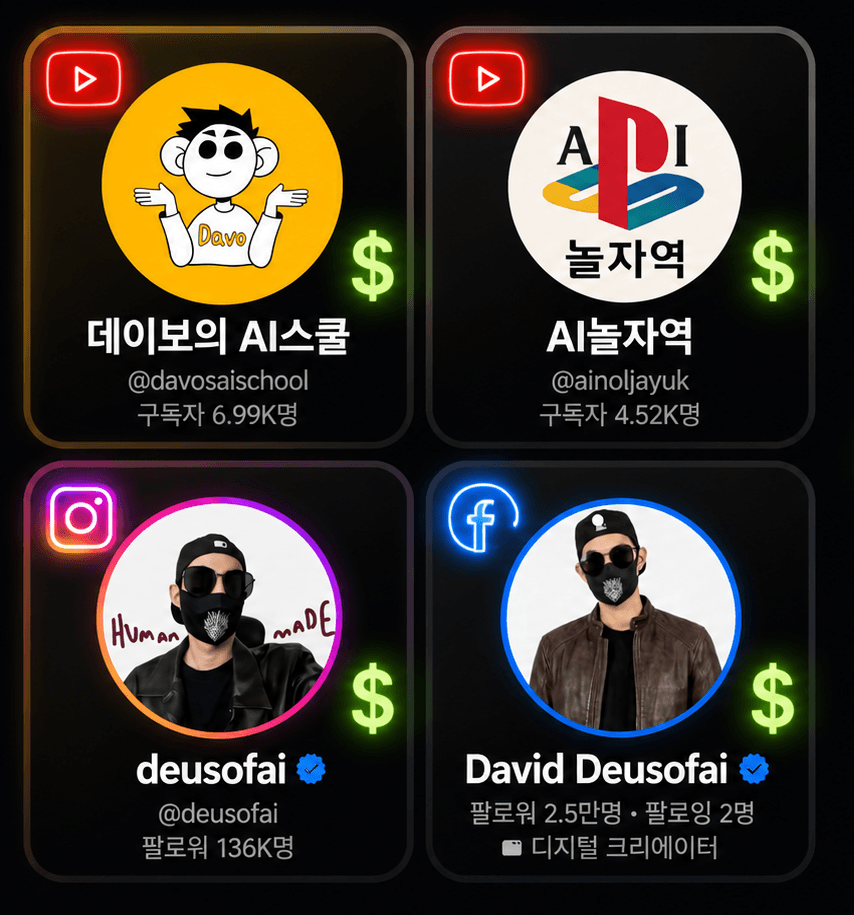

Two monetized YouTube channels. Facebook monetization. 100,000 Instagram followers in four months. And one uncomfortable conclusion.

YouTube🔽
https://www.youtube.com/@davosaischool
https://www.youtube.com/@ainoljayuk
Instagram🔽
www.instagram.com/deusofai
Facebook🔽
https://www.facebook.com/profile.php?id=61590770005598
The AI industry has a serious honesty problem.
Every day, social media is flooded with people promising passive income, one-click businesses, automated content factories, and overnight success. They tell you that AI can build your company, create your videos, grow your channel, develop your app, and make money while you sleep.
It is a powerful story.
It is also, in many cases, dangerously misleading.
Fear sells. Hope sells. And the fantasy of becoming rich without skills, experience, or years of effort may sell better than anything else.
I understand why people want to believe it—because I wanted to believe it too.
But after spending a full year building with AI, monetizing channels, losing channels, starting again, growing an Instagram account to 100,000 followers, and finally generating income across YouTube, Instagram, and Facebook, I have reached a very different conclusion:
AI can make a skilled person dramatically faster. It cannot magically turn an inexperienced person into a successful filmmaker, entrepreneur, developer, or content creator.
This is not a post from someone who watched a few AI tutorials and formed an opinion. I entered this industry because I wanted to test its promises for myself.
Here is what actually happened.
My One-Year AI Journey: The Results—and the Cost Behind Them
I began at the end of June last year.
Within 50 days, I monetized an AI animation channel on YouTube. I later launched an AI education channel and monetized that one in under three months.
From the outside, that sounds like a clean success story.
It was not.
For roughly two months, I fought to recover ownership of my YouTube channels after losing access to them. A newer AI channel I had started was beginning to gain momentum, but it was ultimately removed. While I was trying to recover from that loss, other people reposted some of my best-performing videos on Instagram and received millions of views from work I had created.
At the time, I was working a regular job and continuing my professional creative work. I spent mornings and evenings making content, worked through weekends, lost sleep, became sick, and ended up in the hospital.
Then, on March 13, I started again.
This time, I focused on Instagram. Exactly four months later, on July 13, the account reached 100,000 followers.
Facebook came with its own problems, but I eventually qualified for monetization there as well. In fact, I met the performance requirements so quickly that I still had to wait for the account itself to become old enough to apply.
After one year, the headline results looked impressive:
Two YouTube channels monetized
One Facebook account monetized
100,000 Instagram followers gained in four months
Revenue generated across three major platforms
But the lessons behind those numbers are far more important than the numbers themselves.
Why AI Misinformation Spreads So Easily
Honest advice is often less exciting than a lie.
“This may take several years, require specialized skills, and still fail” is not an attractive thumbnail.
“Click once and make $10,000 a month” is.
That is why exaggerated AI content spreads so quickly. Its creators do not need every viewer to succeed. They only need viewers to feel enough fear, urgency, or greed to click, follow, or buy.
The comments often say things like:
“I can’t believe you are sharing this incredible information for free. You are an angel.”
That level of trust can form before the viewer has verified whether the creator’s results are real, repeatable, profitable, or even connected to the method being sold.
Some people then pay for courses promising YouTube income, automated channels, passive revenue, or AI businesses—without understanding the amount of skill, testing, labor, and risk involved.
To be clear, I am not saying that every course is a scam. Excellent teachers exist. But a polished sales page and a large audience do not automatically make someone trustworthy.
Before buying any course, study how credible business operators evaluate education, proof, and incentives. In Korea, I recommend watching Jangsa-ui-Sin’s discussion on this subject. For English-language business content, Alex Hormozi is also worth studying—not because anyone should be followed blindly, but because his advice consistently emphasizes value, execution, and the difficulty of building something real.
The truth is that few people enjoy hearing the truth.
The truth is painful. The road to meaningful success is usually long, uncertain, and demanding. Most people would rather hear that AI can create a company, channel, app, or film for free—and that they can sell it immediately and become rich.
I know that temptation because I felt it myself.
I spent money and time on both Korean and international courses. Eventually, I decided that the only responsible way to speak about this market was to enter it myself, produce real work, and continue until I had measurable results.
Only then could I separate what sounded good from what actually worked.
These are the most important things I learned.
Lesson 1: AI Is Much Less Intelligent Than the Marketing Suggests
AI is powerful.
It is also unreliable, inconsistent, and often surprisingly stupid.
Promoters describe AI as a universal revolution. Their favorite words are automatic, easy, fast, and one-click. Those words attract attention, especially from people who have not yet worked deeply with the technology.
The deeper you go, however, the more obvious its limitations become.
Companies have publicly experimented with replacing workers using AI, only to discover that automated systems still require human supervision, judgment, correction, and accountability. Some organizations have had to reconsider those decisions or bring people back into workflows that AI could not handle reliably.
My experience led me to the same conclusion long before the wider backlash became visible:
AI is not as capable as the headlines make it sound.
Whenever friends, family members, or aspiring creators ask me about AI, I give them the same answer:
AI is a tool that can dramatically increase the speed of someone who already has professional knowledge. It is not an automatic system that allows a complete beginner to become rich or instantly succeed in filmmaking, content creation, business, or app development.
A filmmaker can use AI to produce concepts faster.
A designer can explore more variations.
A developer can accelerate certain parts of coding.
A marketer can test more ideas.
But the tool still needs direction. And good direction comes from taste, experience, domain knowledge, and judgment.
AI does not eliminate expertise. In many cases, it makes expertise even more valuable.
Lesson 2: “You Can Make a Fortune” Is a Hook, Not a Business Model
Passive income.
Automated revenue.
Compound growth while you sleep.
These phrases are excellent marketing hooks. But let me show you what platform revenue looked like in my real experience.
My AI animation channel earned approximately ₩200,000 in its first monetized month. In the following months, it often earned only tens of thousands of won.
My AI education channel had a higher advertising rate, but it still generated roughly ₩200,000 to the high ₩300,000 range per month.
You might think, “That is still useful extra money.”
Now consider the labor behind it.
I worked my regular job from around 7 a.m. to 3 p.m. Then I created videos from approximately 10 p.m. until 1 or 2 a.m.—sometimes through the entire night. I also used most of my weekends for production.
Look at the hourly return, not just the revenue screenshot.
A course seller could say that I failed because I lacked talent, strategy, or skill. For the sake of argument, let us assume that criticism is correct.
Would the beginners buying that person’s course have more experience and judgment than I did?
If they are starting from an even earlier stage, how can one “secret method” reliably make each of them ₩10 million per month?
The logic does not hold.
It would be like saying:
“Fighter A entered several boxing matches, won some, and lost some. He only struggled because he was foolish. If complete beginners buy my course, they will enter the ring and immediately win three fights in a row.”
Real experts rarely guarantee outcomes like that. They understand how many variables affect success.
The month I earned approximately ₩2.5 million
There was one month when my combined income reached roughly ₩2.5 million. That included:
AdSense revenue
Branded content and sponsorships
Affiliate commissions
Other platform-based income
That sounds much better—until I provide the missing context.
It happened during an unusually strong month with several advertising opportunities. I barely slept. I became sick and went to the hospital for an IV. And that income level was not repeated consistently.
Calling it “monthly income” without that context would be misleading. It would be more honest to treat it as a one-time result within the entire year.
This is why you should never evaluate a business from a single revenue number.
Ask:
How many hours did it require?
How much did production cost?
Was the result repeatable?
How much came from one-time sponsorships?
Was it revenue or profit?
What physical and emotional cost did it create?
Could the system survive if the creator stopped working?
I am not staying in this industry because ₩2.5 million made me rich. I am staying because I want to keep improving my skills, growing my name, and eventually building a real business.
That month was not the destination. It was an experiment—and one small step in a much longer process.
Lesson 3: The Fully Automated “AI Content Factory” Is Still a Fantasy
Automation has become one of the most abused words in the AI industry.
The promise is simple: connect several tools, press a button, generate hundreds of videos, and collect millions in revenue.
Now apply basic common sense.
Would you trust a human employee to complete every part of your business exactly as you want, without your involvement?
Probably not.
Even capable employees need direction, review, feedback, and revision. So why would we trust an imperfect AI—which openly makes mistakes—to handle every stage of a creative or business process without supervision?
The closer a workflow gets to full automation, the more control you usually surrender. And as control decreases, quality and originality often decline with it.
This trade-off is unavoidable:
More automationMore human directionFaster outputStronger quality controlGreater volumeBetter creative judgmentMore consistency of processMore originalityLess direct labor per itemMore intentional decisions
Automation can absolutely help with repetitive tasks. It can organize files, generate rough drafts, create variations, prepare data, or accelerate parts of production.
But automating a task is not the same as automating judgment.
Every fully automated video workflow I tested produced work I did not feel was good enough to upload. The output existed, but it did not meet my standards.
That distinction matters.
Creating more content is not the same as creating content people want.
Until an AI can reproduce your taste, priorities, experience, and judgment—essentially, until it can reproduce your mind—complete creative automation will remain far less useful than the marketing suggests.
If someone repeatedly promises a completely automated content empire, you do not need to argue with them. Close the video and move on.
Lesson 4: “Copy My System” Courses Create Crowded Markets, Not Independent Creators
Imagine that someone owns a coffee shop on a street in Apgujeong.
The owner claims that the shop made ₩100 million in revenue last month. They offer to sell you a ₩3 million program that will create an identical coffee shop at the click of a button.
One hundred people buy it.
Now all 100 people open nearly identical coffee shops on the same street, serving the same customers with the same products and the same marketing.
What happens?
The street becomes overcrowded. Customers lose interest. Revenue gets divided among more competitors. Most of the shops fail together.
You might say, “They could simply open on different streets.”
But in content creation, many copy-and-paste systems do not truly send students to different streets. They teach the same niche, format, subject, tools, hooks, audience, and monetization method. The channels may have different names, but they are competing in the same digital alley.
There is an even deeper problem.
Those new owners never learned:
How to build from zero
How to understand customers
How to respond when performance declines
How to improve the product
How to manage costs, revenue, and taxes
How to adapt when the market changes
How to recover from failure
They started with a copied version of someone else’s successful shop.
When it stops working, they have no idea what to do next.
It is like buying a level-100 character in a video game while possessing level-one knowledge. You may own the character, but you still have to learn every skill, dungeon, monster, item, and strategy that the original player mastered along the way.
Worse, once thousands of people buy the same shortcut, the competition becomes even harder. The legendary item that once attracted 100 players now attracts 10,000.
That is the fundamental weakness in many “copy my exact system” courses.
A template can save time. A technique can help. A framework can shorten the learning curve.
But no system can give you the judgment that comes from building, failing, analyzing, and adapting for yourself.
The Most Honest Advice I Can Give You
After one year of earning money with AI, here is my real formula:
Work extremely hard → fail → identify why you failed → learn something new → test it in the real world → analyze the result → improve it → repeat.
That is not a glamorous secret.
It is simply how progress works.
If the test succeeds, move to the next challenge. If it fails, return to the analysis stage. Keep the useful lesson and begin again.
I also need to be honest about speed.
AI is developing at an extraordinary pace. If you approach this field casually while expecting fast financial results, you will probably be disappointed. There is nothing wrong with learning slowly as a hobby. But slow, occasional effort and rapid professional success are not the same goal.
For the last year, I rarely met friends. I barely went out. I treated holidays as opportunities to work through the night.
I am not presenting that lifestyle as healthy or sustainable. In fact, becoming sick taught me that ambition without recovery has consequences. Hard work matters, but destroying your health is not a badge of honor.
What the experience did teach me is that genuinely successful people rarely describe their journey as easy, fast, or automatic.
Whether you study Alex Hormozi, respected chefs, experienced entrepreneurs, or builders such as Elon Musk and Steve Jobs, the message is very different from the promises made by get-rich-quick sellers:
Meaningful success usually requires obsessive effort, prolonged uncertainty, sacrifice, and repeated failure.
I am nowhere near the level of those people. But even while growing four channels, I felt a small version of the same truth.
Nothing about it was easy.
I lost sleep. I lost weight. I became seriously ill and needed IV treatment more than once. Before achieving even these modest results, I had to survive many earlier attempts that produced nothing.
I have also passed intermediate-level examinations in two foreign languages, won a small amateur sports competition, earned a living in a creative field, and grown multiple channels.
None of those achievements makes me extraordinary.
That is exactly the point.
Even modest achievements required an enormous amount of time, effort, and persistence. So when someone promises an effortless path to ₩10 million a month, I cannot accept the claim without extraordinary proof.
I am still working toward that level of income myself—with the full expectation that the next stage will be harder, not easier.
How to Protect Yourself From AI Hype
Before trusting an AI income claim, ask these questions:
Is the creator showing revenue, or actual profit?
Revenue screenshots do not reveal software costs, advertising expenses, outsourcing, refunds, taxes, or labor.
Is the result repeatable?
One viral video or one exceptional sponsorship month is not a stable business.
Does the creator earn more from the method—or from teaching the method?
If course sales are the primary business, that does not automatically invalidate the course. But it changes how you should evaluate the claim.
Are failures and risks included?
Honest educators explain what can go wrong, who the method is not for, and what skills are required.
Is there a guaranteed financial outcome?
Be deeply skeptical of anyone promising specific income from a system that depends on audience behavior, platform algorithms, market timing, or creative quality.
Would the method still work if thousands of students copied it?
If mass adoption destroys the opportunity, the real product may be the course—not the strategy.
Does “automation” still require human review?
Ask who checks facts, corrects errors, protects quality, handles copyright risk, and makes final decisions.
What is missing from the success story?
Look for the time invested, previous experience, existing audience, team size, capital, network, and failed attempts.
Good education should make you more capable and independent.
Bad education makes you dependent on the next secret, template, update, or upsell.
Final Thoughts: Use AI, but Do Not Worship It
News media and social platforms are rewarded for attention. Fear, exaggeration, distorted information, and extreme claims often receive more engagement than calm truth.
That creates the perfect environment for opportunists.
Again, good courses and honest teachers do exist. But finding them is difficult. Before giving someone your money, study their incentives, examine their evidence, and ask whether they are teaching durable skills or selling a fantasy.
When someone says the process is easy, fast, automatic, and guaranteed to make you rich, close the video.
Or, if the content contains one genuinely useful technique, learn that technique—then leave the fantasy behind.
AI is not useless. Far from it.
AI is one of the most powerful creative and professional tools available today. But it works best in the hands of people who are willing to learn, practice, think critically, and take responsibility for the final result.
Do not look for a button that replaces the journey.
Build your skills. Create real value. Test your ideas. Study your failures. Protect your health. Keep your standards high. And surround yourself with strong, honest, warm-hearted people who have achieved something real without losing their humanity.
I hope more people like that find one another—and build communities with enough knowledge, influence, and strength to improve this industry.
Thank you for reading.
Leave a Reply